

 Jul 03, 2025
 5 min read
The Digestive Tract, Section by Section: What Each Part Does and What Goes Wrong

Every day, roughly nine litres of fluid pass through the gut: about two litres from food and drink, and around seven litres of saliva, stomach juice, bile and other secretions the body adds itself. By the time it reaches the end, only 100 to 200 ml leaves in stool. The rest is absorbed along the way. Following that route section by section explains what each part does, and why problems show up where they do.
Mouth and oesophagus
Digestion starts before you swallow. Chewing breaks food into smaller pieces, and the 0.5 to 1.5 litres of saliva produced each day moistens it and starts breaking down starch with the enzyme amylase. Swallowing pushes each mouthful into the oesophagus, a muscular tube about 25 cm long. Waves of muscle contraction carry it to the stomach in a few seconds, which is why you can swallow even while upside down.
At the bottom of the oesophagus a ring of muscle, the lower oesophageal sphincter, normally stops stomach contents flowing back up. When it relaxes at the wrong times, the result is heartburn and reflux.
Stomach
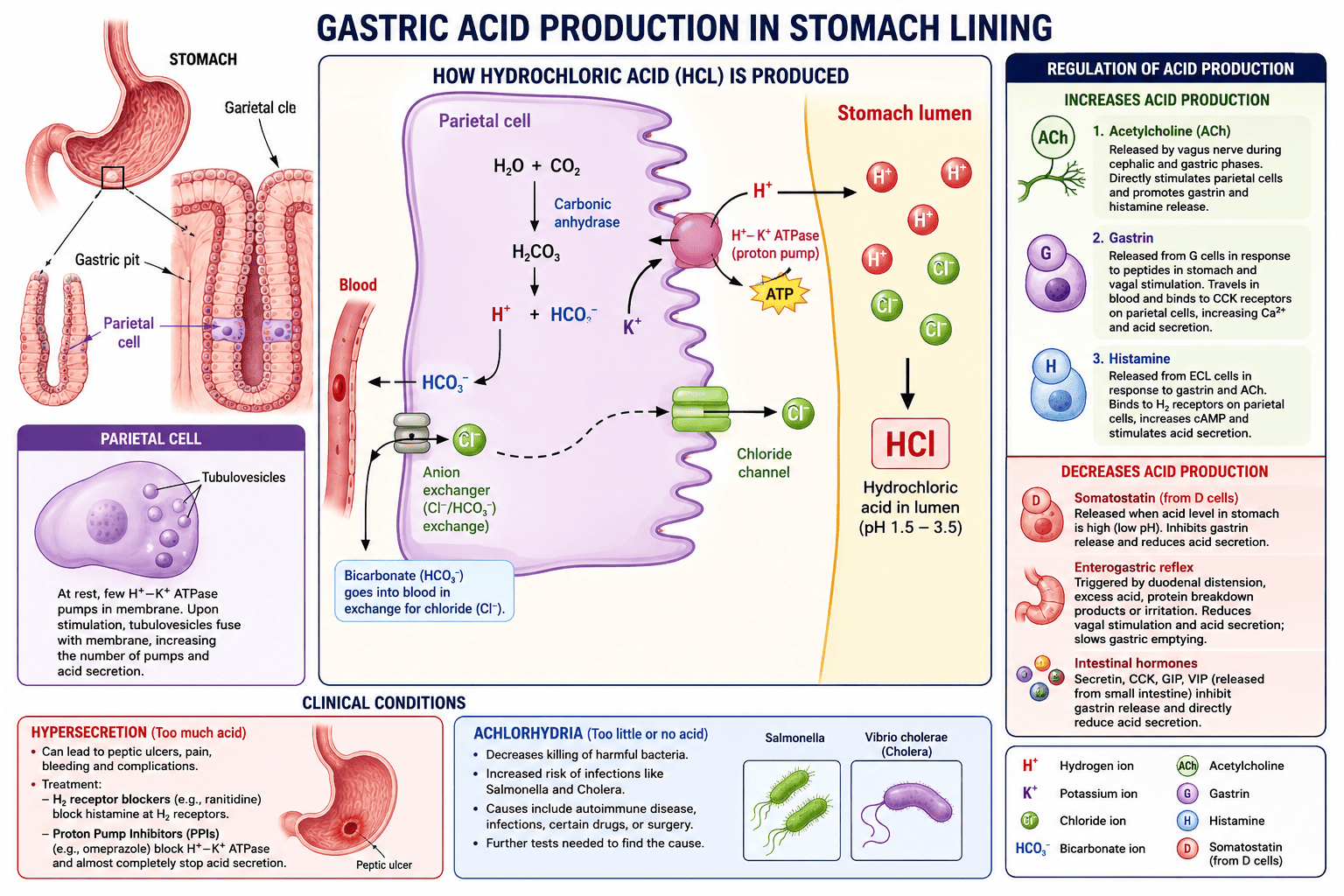
The stomach stretches to hold a meal, often more than a litre. It mixes the food with hydrochloric acid strong enough (pH 1.5 to 3.5) to kill most bacteria, and with pepsin, an enzyme that starts digesting protein. A thick layer of mucus and bicarbonate protects its own lining. Painkillers such as ibuprofen, naproxen and aspirin weaken that protection, which is why they can cause ulcers. So can the bacterium Helicobacter pylori (see our guide to stomach ulcers).
The stomach also makes intrinsic factor, a protein needed to absorb vitamin B12 further down. That has a practical side for medicines. Long-term use of acid-reducing drugs (omeprazole and similar) or metformin can lower B12 levels. People who take them for years may need an occasional blood test.
A normal meal leaves the stomach over two to four hours, faster for liquids and slower for fatty food.
Small intestine
This is where most digestion and absorption happen. In a living adult it is around three to five metres long, in three parts: the duodenum, jejunum and ileum. In the duodenum, bile from the liver and gallbladder breaks fat into tiny droplets, and juice from the pancreas adds enzymes for fat, protein and starch, plus bicarbonate to neutralise the acid.
The lining is folded into finger-like villi, which are covered in even smaller microvilli. For years textbooks said this gave the gut the surface area of a tennis court. A 2014 re-measurement put the whole digestive tract at about 32 square metres, roughly the floor of a small flat. That is still large, but nowhere near a tennis court.
Different nutrients are absorbed at different points. Iron is absorbed mainly in the duodenum. Vitamin B12 and bile salts are taken up at the far end of the ileum. That is why surgery or Crohn's disease affecting the last part of the ileum can cause B12 deficiency.
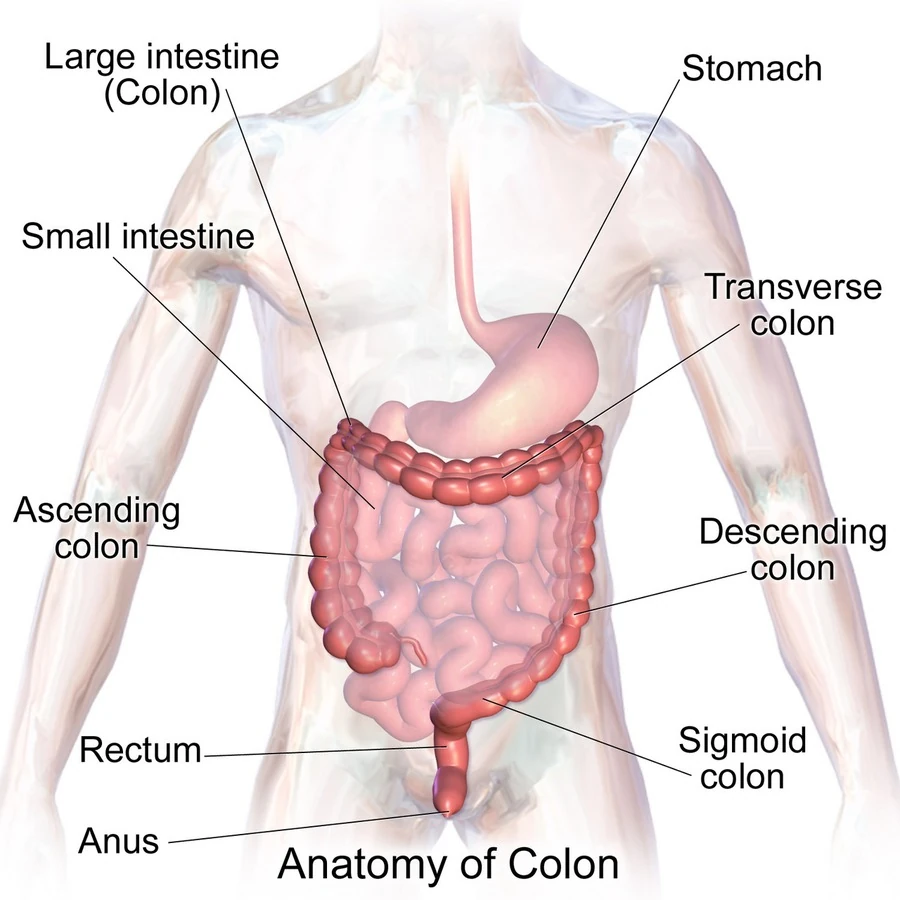
The colon is about 1.5 metres long and home to most of the gut's bacteria. Image: Blausen Medical / Wikimedia Commons, CC BY 3.0
Large intestine
The colon is about 1.5 metres long. It absorbs most of the remaining water and salts, turning liquid into stool. It is also home to most of the gut's bacteria. A 2016 estimate put the number at about 38 trillion, roughly equal to the number of human cells in the body. The old claim of ten bacteria for every human cell was wrong.
These bacteria ferment the fibre we can't digest, producing short-chain fatty acids that feed the cells lining the colon. That is one reason fibre matters for bowel health. Food usually takes one to three days to travel from mouth to toilet, but this varies widely between healthy people.
The helpers: liver, gallbladder and pancreas
These organs sit outside the tube but are part of digestion. The liver makes bile and processes everything absorbed from the gut before it reaches the rest of the body, including most medicines. The gallbladder stores bile and squeezes it out after fatty meals, which is why gallstone pain often follows a heavy meal. The pancreas makes digestive enzymes as well as insulin.
What goes wrong, and where
- Oesophagus: reflux disease. Food sticking on swallowing is a symptom that always needs checking.
- Stomach and duodenum: gastritis and peptic ulcers, mostly from H. pylori or anti-inflammatory painkillers.
- Small intestine: coeliac disease, an immune reaction to gluten that affects about 1 in 100 people, many of them undiagnosed. Also Crohn's disease.
- Colon: irritable bowel syndrome (common, affecting around 1 in 10 people), ulcerative colitis, diverticular disease and bowel cancer.
- Gallbladder and pancreas: gallstones and pancreatitis.
Keeping it working
The habits with the best evidence are simple: eat about 30 g of fibre a day, drink enough fluid, stay active, don't smoke, and keep alcohol moderate. Use anti-inflammatory painkillers only at the lowest dose for the shortest time. Take part in bowel cancer screening when invited. It is offered from age 50 in the UK and from 45 in the US, and it finds cancers early, when they are most treatable (NHS screening information).
See a doctor promptly for blood in the stool or black, tarry stools, difficulty swallowing, repeated vomiting, unexplained weight loss, or a change in bowel habit lasting more than a few weeks. Iron tablets also turn stools black, but those stools are usually dark green-black and formed, not sticky and tar-like.
Sources
- Helander H, Fändriks L, "Surface area of the digestive tract – revisited", Scandinavian Journal of Gastroenterology 49 (2014): 681-689. https://doi.org/10.3109/00365521.2014.898326
- Sender R, Fuchs S, Milo R, "Revised Estimates for the Number of Human and Bacteria Cells in the Body", PLOS Biology 14 (2016): e1002533. https://doi.org/10.1371/journal.pbio.1002533
- NHS, "Bowel cancer screening". https://www.nhs.uk/tests-and-treatments/bowel-cancer-screening/



Comments (0)
Leave a Reply
Comments are moderated. Please read our Comment Policy before posting.
Log in to post a comment.