

 Sep 29, 2026
 5 min read
What Your BMI Does — and Doesn't — Tell You
Body Mass Index tells you exactly one thing: the ratio between your weight and the square of your height. That's it. It doesn't measure body fat, muscle, bone density, or where your weight sits on your frame — and yet a single BMI number is often treated as a verdict on someone's health. Understanding what the formula actually captures, and what it quietly ignores, makes it a much more useful number to have.
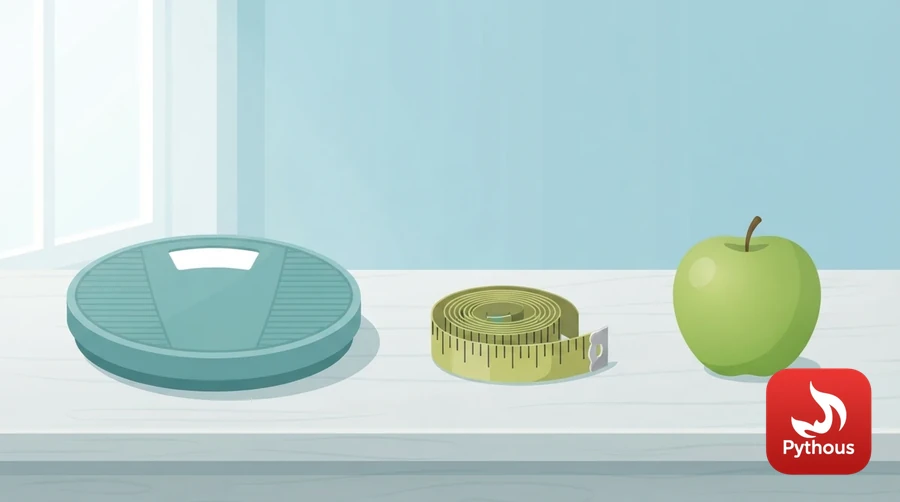
Illustration: BMI is worked out from weight and height alone, so it can't tell muscle from fat.
Where BMI actually comes from
BMI wasn't designed by doctors to assess individual health. It was developed in the 1830s by the Belgian mathematician Adolphe Quetelet, who was trying to describe the statistical distribution of body size across a population, not diagnose any one person. The formula is simple: weight in kilograms divided by height in meters squared (kg/m²), or weight in pounds divided by height in inches squared, multiplied by 703.
It stayed a demographic tool for over a century. Insurance companies and later public health researchers adopted it in the mid-20th century as a cheap, fast way to flag population-level trends — because unlike body fat percentage, it requires no special equipment, just a scale and a tape measure. That convenience is the entire reason it became the default screening number doctors use today. You can check your own in seconds with a BMI calculator, which does the arithmetic instantly.
What the categories mean — and their limits
The standard adult categories are: below 18.5 is classified underweight, 18.5–24.9 is "normal," 25–29.9 is overweight, and 30 and above is obese. These thresholds were set by expert panels using population data linking BMI to health outcomes like cardiovascular disease and diabetes risk, and at a population level, the correlation is real — average BMI does track with average disease risk across large groups.
The trouble starts when you apply a population-level correlation to a single individual. BMI cannot distinguish between a bodybuilder carrying significant muscle and someone carrying the same weight in fat — both can land in the same "overweight" bracket despite having very different health profiles. It also doesn't account for where fat is stored. Visceral fat around the abdominal organs is associated with meaningfully higher cardiovascular and metabolic risk than fat stored elsewhere, and two people with identical BMI can have very different amounts of it.
Age, sex, and ethnicity add further wrinkles. Older adults naturally lose muscle mass, so a "normal" BMI later in life can mask a higher proportion of body fat than the same number would in a younger person. Women, on average, carry a higher percentage of body fat than men at the same BMI. And several public health bodies have noted that some Asian populations show elevated diabetes and cardiovascular risk at BMI levels the standard chart still labels "normal," which is why some countries use lower thresholds for those groups.
What BMI is genuinely good for
None of this makes BMI useless — it makes it a screening tool rather than a diagnosis. At a population scale, tracking average BMI over time is a legitimate way to monitor public health trends, because the individual quirks tend to average out across millions of people. For an individual, a BMI far outside the normal range (very low or very high) is a reasonably reliable flag that further evaluation is worth having, even if it can't tell you what's actually going on.
Used this way — as a quick first-pass signal rather than a final answer — it does what Quetelet's original arithmetic was built for: giving a cheap, consistent number that's easy to calculate and easy to compare over time. Pairing it with other measures, like waist circumference, body fat percentage, or simply how your fitness and bloodwork are trending, gives a far more complete picture than the ratio alone ever could.
What to look at instead — or alongside it
- Waist circumference: A more direct proxy for visceral fat than BMI, since it measures where fat is concentrated rather than just total mass relative to height.
- Waist-to-hip ratio: Captures body fat distribution, which matters more for cardiovascular risk than total weight alone.
- Body composition: Tools like skinfold calipers, bioelectrical impedance scales, or DEXA scans separate fat mass from lean mass — something BMI structurally cannot do.
- Trends over time: A rising or falling BMI for the same person, measured consistently, is often more informative than a single snapshot compared against a general chart.
If you're also tracking energy balance alongside weight, a calorie calculator can help estimate daily needs based on your activity level, which is a more actionable number for day-to-day decisions than BMI alone.
The honest takeaway
BMI is a population statistic wearing the costume of a personal diagnosis. It was never built to account for muscle, fat distribution, age, or ethnicity, and it doesn't. That doesn't make it worthless — it's still a fast, free, reasonably useful first checkpoint — but it works best as one data point among several, not as a standalone judgment on anyone's health.
Frequently asked questions
Is BMI different for men and women?
The formula and standard categories are the same for both, but because women typically carry a higher percentage of body fat than men at an equivalent BMI, the same number can represent a different body composition depending on sex.
Why do athletes sometimes get an "overweight" BMI reading?
Because BMI only accounts for total weight relative to height, it can't separate muscle from fat. Muscle is denser than fat, so muscular individuals often weigh more per unit of height and can be classified as overweight or obese despite having low body fat.
What's a better alternative to BMI?
There isn't a single perfect replacement, but combining BMI with waist circumference or waist-to-hip ratio gives a fuller picture, since those measures capture fat distribution rather than just total mass. For a precise breakdown, body composition testing (like DEXA or bioelectrical impedance) goes further still.
This article is for general educational information only and is not medical advice. Consult a qualified healthcare provider for guidance about your individual health.



Comments (0)
Leave a Reply
Log in to post a comment.