
 Aug 19, 2026
 7 min read
Kaunch Seeds (Kaunch Beej): The Ayurvedic "Man Power" Bean
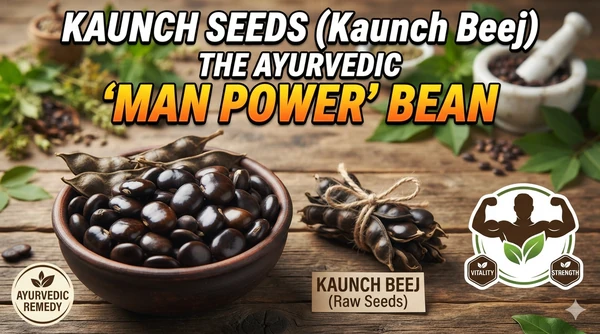
Ask in almost any pansaar shop in Pakistan or northern India for something to improve stamina, and there is a fair chance you will be handed a jar of small, glossy, grey-black beans. These are kaunch beej, the seeds of Mucuna pruriens, a climbing legume known in English as velvet bean or cowhage and in Sanskrit as kapikacchu. They have been used in Ayurvedic medicine for centuries, mostly as a tonic for men and for a "shaking palsy" that physicians now think was Parkinson's disease.
Much of the modern marketing is exaggerated. But the seed does contain something powerful, and that is exactly why it needs more caution than most herbal products.
What is in the seed
Mucuna pruriens is a vigorous twining vine with leaves in threes and hanging clusters of dark purple flowers. Its curved pods hold four to six seeds and are covered in fine brown hairs that cause intense itching and blistering on contact, which is where the name "cowhage" or "cowitch" comes from.
The seeds are unusually rich in L-DOPA, typically about 3 to 7 per cent of their weight. L-DOPA is the molecule the brain turns into dopamine, the chemical messenger involved in movement, motivation and reward. It is also, under the name levodopa, the most important drug for Parkinson's disease, which is caused by the loss of dopamine-producing nerve cells. Dopamine also suppresses the hormone prolactin and influences the hormones that control testosterone and sperm production, which is the basis for the seed's reputation as a remedy for men.
That is the most important thing to understand about kaunch beej. It is not a mild food-like herb. A few grams of seed powder can contain a dose of L-DOPA in the same range as prescription tablets.
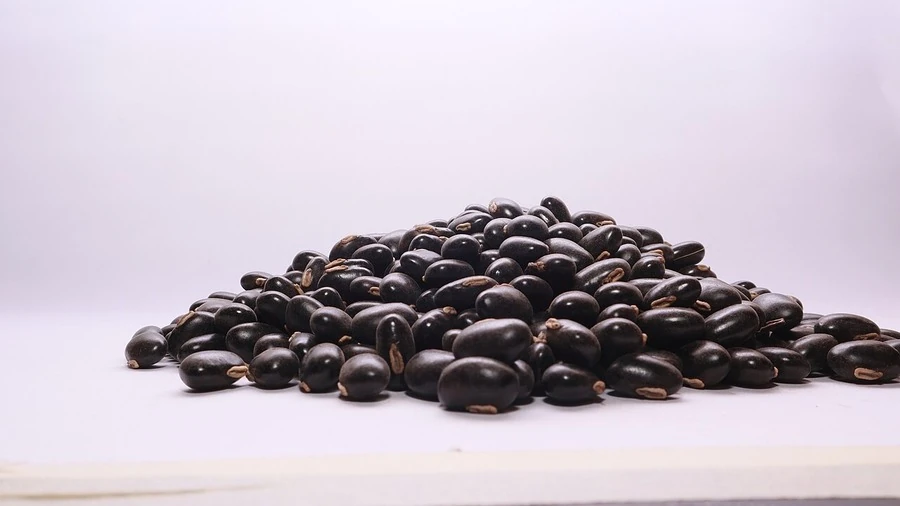
Kaunch seeds and powder; the best human evidence concerns male fertility. Photo: Piyush Kothari / Wikimedia Commons, CC BY-SA 4.0
What the studies show
Male fertility
Most of the human research on fertility comes from one group, led by Kamla Kant Shukla and colleagues in Lucknow. In a study published in Fertility and Sterility in 2009, they compared 75 fertile men with 75 men being assessed for infertility, and gave the infertile men 5 grams of seed powder a day for three months. Testosterone, LH (a hormone that stimulates the testes) and dopamine rose, prolactin fell, and sperm count and motility improved. In an earlier study of 60 infertile men under psychological stress, the same dose for three months lowered cortisol and improved semen quality.
These results are encouraging but limited. The studies were small, came from a single research group, and did not compare the seed with a placebo, so some of the improvement may have happened anyway. They also involved men with measurable fertility problems. There is no good evidence that the seed boosts hormones or sperm in healthy men with normal levels.
Parkinson's disease
The neurological research is more rigorous. In 2004 Regina Katzenschlager and colleagues in London ran a small double-blind trial in eight people with Parkinson's, comparing single doses of mucuna powder with standard levodopa tablets. A 30-gram dose of the powder worked faster and lasted somewhat longer than the tablets, without more involuntary movements. In 2017 Roberto Cilia and colleagues from the Parkinson Institute in Milan, working with a clinic in Santa Cruz, Bolivia, reported a randomised, double-blind trial in 18 patients with advanced Parkinson's. Single doses of powder from roasted seeds worked about as well as standard levodopa. Researchers are interested in it as a cheaper option for people in low-income countries who cannot afford levodopa.
That is a reason for medical research, not for self-treatment. Parkinson's medication has to be balanced carefully, and anyone with the condition should only use mucuna under a neurologist's supervision.
Claims to doubt
Claims that kaunch beej raises growth hormone and builds muscle rest on very thin evidence. It is not an instant aphrodisiac; the fertility studies measured changes over three months. And while some animal studies suggest it may lower blood sugar, that is a reason for caution in people on diabetes medicine, not a cure for diabetes.
Claims about growth hormone and instant effects rest on very thin evidence. Photo: Jonathan Borba / Pexels
Safety and interactions
Because the active ingredient is a drug, the side effects and interactions are those of levodopa. The common ones are nausea, vomiting, bloating, headache, dizziness, restlessness and difficulty sleeping. At higher doses it can cause low blood pressure on standing, palpitations, involuntary movements and, rarely, confusion or psychosis; there are published case reports of psychosis after taking mucuna. L-DOPA can also darken urine and sweat, which is harmless.
It should not be taken without a doctor's advice by anyone who:
- takes antidepressants, especially MAO inhibitors, which can interact dangerously with L-DOPA
- takes antipsychotic medicines, which block dopamine and would be opposed by it
- already takes levodopa or other Parkinson's medicines
- takes medicines for diabetes or blood pressure
- has schizophrenia, bipolar disorder or a history of psychosis, a heart rhythm problem, glaucoma, or a history of melanoma
- has liver or kidney disease
- is pregnant or breastfeeding
Product quality is a real problem. When Amala Soumyanath and colleagues at Oregon Health and Science University tested commercial mucuna products sold online, the L-DOPA content varied widely and often did not match the label. That means the same "dose" of two brands can deliver very different amounts of the drug. Raw seeds also contain substances that cause stomach upset, which is why traditional preparation (shodhana) involves soaking and boiling, usually in milk, and removing the seed coat before drying and grinding. Raw, unprocessed seeds should not be eaten.
Growing it
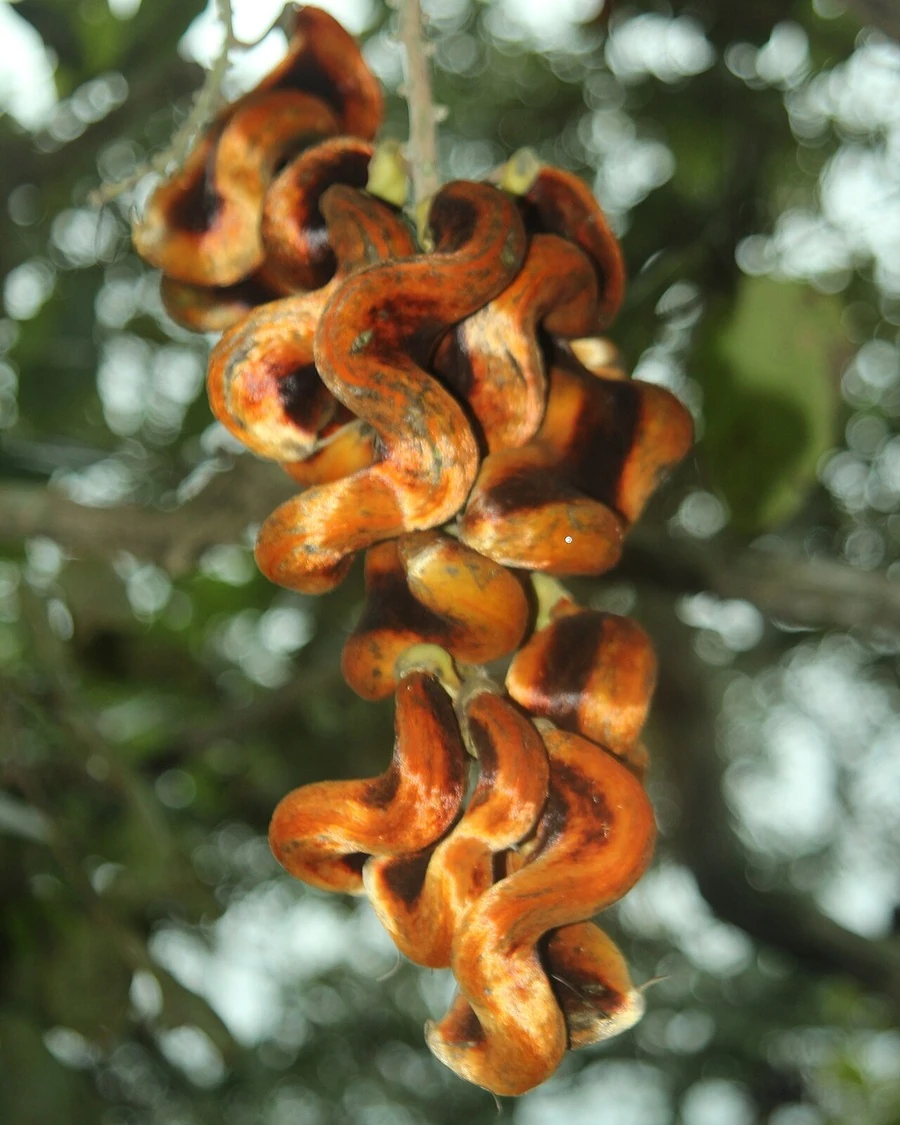
Kaunch grows well in warm summers, but the hairs on its pods cause blisters on contact. Photo: 4toscenethesis / Wikimedia Commons, CC BY-SA 4.0
The plant grows well in the hot summers and monsoon of Pakistan and northern India. It needs full sun, a strong fence, trellis or tree to climb (the vines can run many metres), and is usually sown just before the monsoon, in June or July, after soaking the hard seeds overnight. As a legume it fixes its own nitrogen and is grown in many tropical countries as a green manure. Flowers come a few months after sowing, and pods ripen and dry on the vine.
The pod hairs are the problem. They contain an enzyme, mucunain, and other irritants that cause severe itching, and they come loose and blow around at harvest. Anyone handling the pods needs long sleeves, gloves, eye protection and a mask, and the plant should not be grown where children or pets play. For most people who only want the powder, a tested commercial product, used with a doctor's agreement, is safer than growing, harvesting and processing the seeds at home.
Sources
- Kamla Kant Shukla, Abbas Ali Mahdi, Mohammad Kaleem Ahmad et al., "Mucuna pruriens improves male fertility by its action on the hypothalamus–pituitary–gonadal axis", Fertility and Sterility 92 (2009): 1934–1940. https://doi.org/10.1016/j.fertnstert.2008.09.045
- Kamla Kant Shukla, Abbas Ali Mahdi, Mohammad Kaleem Ahmad et al., "Mucuna pruriens reduces stress and improves the quality of semen in infertile men", Evidence-Based Complementary and Alternative Medicine 7 (2010): 137–144. https://doi.org/10.1093/ecam/nem171
- R. Katzenschlager, A. Evans, A. Manson et al., "Mucuna pruriens in Parkinson's disease: a double blind clinical and pharmacological study", Journal of Neurology, Neurosurgery and Psychiatry 75 (2004): 1672–1677. https://doi.org/10.1136/jnnp.2003.028761
- Roberto Cilia, Janeth Laguna, Erica Cassani et al., "Mucuna pruriens in Parkinson disease: a double-blind, randomized, controlled, crossover study", Neurology 89 (2017): 432–438. https://doi.org/10.1212/wnl.0000000000004175
- Amala Soumyanath, T. Denne, A. Peterson et al., "Assessment of commercial formulations of Mucuna pruriens seeds for levodopa (L-DOPA) content", BMC Complementary and Alternative Medicine 12, suppl. 1 (2012): P36. https://doi.org/10.1186/1472-6882-12-s1-p36
- L. R. Lampariello, A. Cortelazzo, R. Guerranti et al., "The magic velvet bean of Mucuna pruriens", Journal of Traditional and Complementary Medicine 2 (2012): 331–339. https://doi.org/10.1016/s2225-4110(16)30119-5




Comments (0)
Leave a Reply
Comments are moderated. Please read our Comment Policy before posting.
Log in to post a comment.