

 Oct 16, 2026
 6 min read
How Sleep Repairs Your Brain: The Science of Deep Sleep
Deep sleep is the part of the night when you are hardest to wake. On an EEG, which records the brain's electrical activity through the scalp, it shows up as large, slow delta waves, between about half a cycle and four cycles a second, produced by huge numbers of neurons switching on and off together. Sleep scientists call it stage N3, or slow-wave sleep. It takes up roughly 15 to 25 per cent of a young adult's night, and it is when several of the brain's maintenance jobs seem to happen.
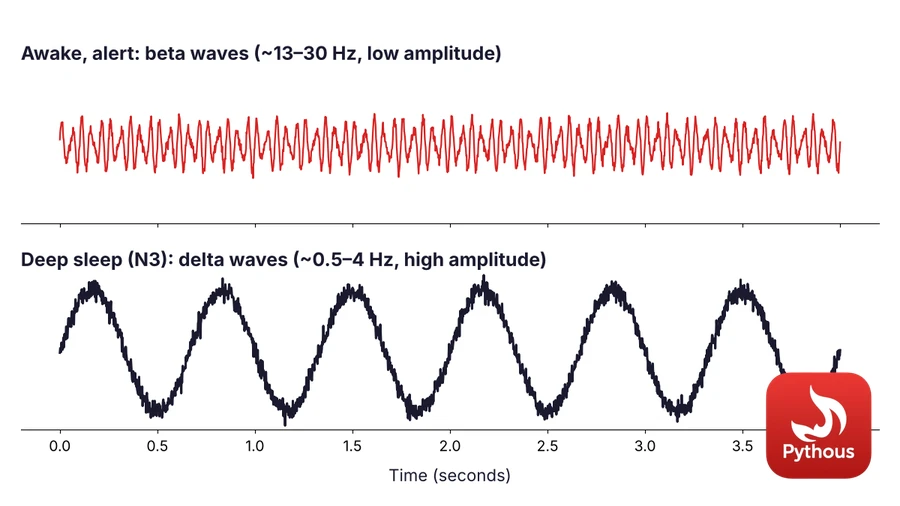
Chart: illustrative EEG waveforms showing the frequency and amplitude contrast between waking beta activity (~13–30 Hz) and the slow-wave delta activity (~0.5–4 Hz) that defines N3 deep sleep.
When deep sleep happens
A night runs in cycles of about 90 to 120 minutes, each passing from light sleep (N1 and N2) into deep sleep (N3) and then REM sleep, when most vivid dreaming happens. The cycles are not alike. Most deep sleep comes in the first two cycles, and later cycles contain little or none, while REM periods get longer towards morning.
That has a practical consequence. Going to bed late costs you mostly deep sleep; waking early costs you mostly REM. Deep sleep also declines with age. A large analysis of sleep studies by Maurice Ohayon and colleagues in 2004 found the share of slow-wave sleep falling steadily through adulthood, and many people over 60 get very little.
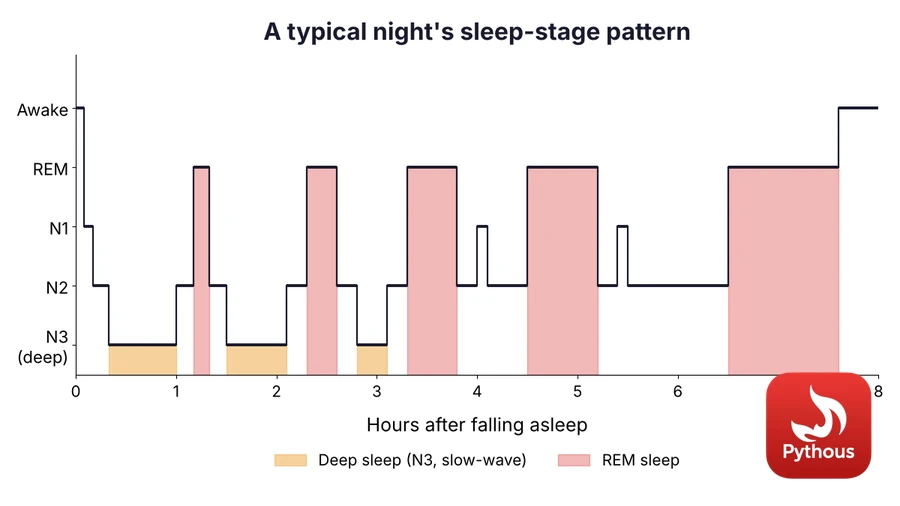
Chart: an idealized sleep-stage pattern across an 8-hour night, based on the well-documented tendency for slow-wave (N3) sleep to concentrate in early cycles and REM periods to lengthen later in the night. Not measured data from an individual sleeper.
Clearing waste
The rest of the body removes waste from between its cells through the lymphatic system, but the brain has no lymphatic vessels in its tissue. In 2012 Maiken Nedergaard's laboratory at the University of Rochester described another route in mice. Cerebrospinal fluid, the clear liquid around the brain, flows into the tissue along the spaces around arteries, mixes with the fluid between brain cells and drains out along veins, carrying waste with it. They named it the glymphatic system, because it depends on glial cells.
A year later the same group reported in Science that in sleeping mice the space between brain cells grew by about 60 per cent, and that beta-amyloid, the protein that builds up in Alzheimer's disease, was cleared about twice as fast as in awake mice. In 2019 Laura Lewis's group at Boston University used fast MRI in sleeping people and saw large, slow pulses of cerebrospinal fluid washing through the brain during non-REM sleep, in step with the slow waves. And in 2018 Ehsan Shokri-Kojori and colleagues at the US National Institutes of Health found that a single night without sleep raised beta-amyloid in the human hippocampus by about 5 per cent.
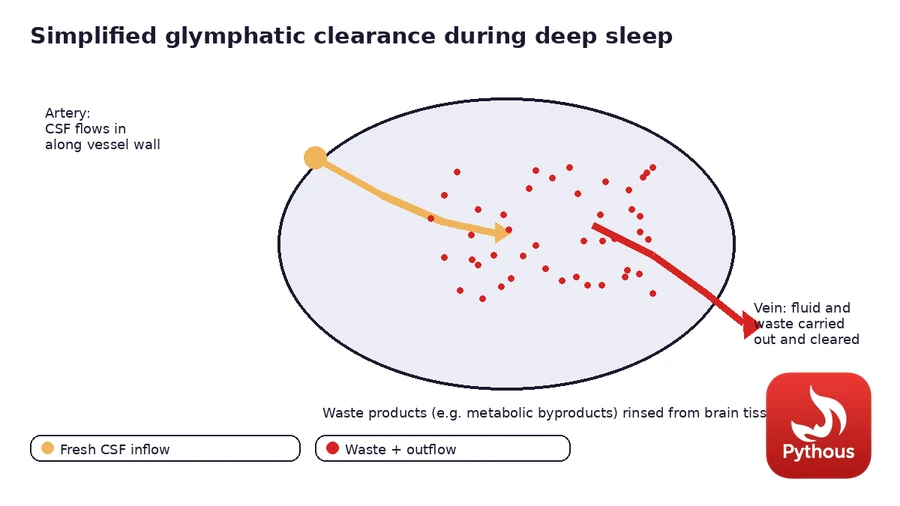
Diagram: a simplified schematic of glymphatic clearance: cerebrospinal fluid enters brain tissue along the space surrounding arteries, mixes with interstitial fluid, and waste products exit along the space surrounding veins.
The story is not settled. In 2024 a team at Imperial College London led by Nicholas Franks and William Wisden reported in Nature Neuroscience that, measured a different way, clearance of a dye from the mouse brain was actually lower during sleep and anaesthesia than when the animals were awake. The two groups disagree about methods, and the question of how much sleep speeds up waste removal in the human brain is still open. What is not in doubt is that sleep loss is linked with higher levels of these waste proteins, and that long-term poor sleep is a risk factor for dementia.
Fixing memories
The evidence on memory is stronger. During the day, the hippocampus holds new memories temporarily. In slow-wave sleep, recordings in animals show the hippocampus replaying the patterns of activity from earlier learning, at several times the original speed, in step with brief bursts of activity called sleep spindles and with the slow waves themselves. This replay is thought to help copy memories to the cortex for long-term storage. In their 2013 review of the field, Björn Rasch and Jan Born summarised dozens of experiments showing that people remember facts and skills better after a night's sleep than after the same time awake, and that the benefit depends particularly on slow-wave sleep.
A complementary idea, from Giulio Tononi and Chiara Cirelli at the University of Wisconsin, is that learning while awake strengthens connections between neurons across the brain, and that deep sleep scales them back down. That would save energy and make room for the next day's learning, while the most-used connections survive.

During deep sleep, the day's memories are thought to be replayed and moved into long-term storage. Photo: Andrea Piacquadio / Pexels
The rest of the body
The largest pulse of growth hormone in the day comes shortly after falling asleep, during the first period of deep sleep, as Yasuro Takahashi and colleagues showed in 1968. It supports tissue repair and, in children, growth. Heart rate and blood pressure fall to their lowest levels of the day. The immune system is also more active at night, which is part of why being ill makes people sleepy.
Some common habits change deep sleep in ways people don't expect. Alcohol in the evening tends to increase deep sleep in the first half of the night, then fragments sleep and suppresses REM in the second half, so the night as a whole is less restful. Many sleeping pills increase light sleep more than deep sleep. An irregular schedule and late-night screens shift the timing of sleep, which can cut into the early cycles where most deep sleep sits.
Consumer sleep trackers are less useful here than their apps suggest. In a 2021 comparison of seven devices against laboratory polysomnography, Evan Chinoy and colleagues found most were good at telling sleep from wakefulness, but much less accurate at identifying specific stages such as deep sleep. Treat the nightly "deep sleep" figure as a rough estimate.
The advice that follows from all this is ordinary: aim for at least seven hours, as US sleep-medicine bodies recommend for adults, keep a regular schedule so the deep-sleep-rich early cycles aren't cut short, and keep alcohol away from bedtime. Snoring with pauses in breathing, or daytime sleepiness despite enough hours in bed, are reasons to see a doctor, because sleep apnoea fragments deep sleep and is very treatable.
Sources
- Lulu Xie, Hongyi Kang, Qiwu Xu et al., "Sleep drives metabolite clearance from the adult brain", Science 342 (2013): 373–377. https://doi.org/10.1126/science.1241224
- Nina E. Fultz, Giorgio Bonmassar, Kawin Setsompop et al., "Coupled electrophysiological, hemodynamic, and cerebrospinal fluid oscillations in human sleep", Science 366 (2019): 628–631. https://doi.org/10.1126/science.aax5440
- Andawei Miao, Tianyuan Luo, Bryan Hsieh et al., "Brain clearance is reduced during sleep and anesthesia", Nature Neuroscience 27 (2024): 1046–1050. https://doi.org/10.1038/s41593-024-01638-y
- Ehsan Shokri-Kojori, Gene-Jack Wang, Corinde E. Wiers et al., "β-Amyloid accumulation in the human brain after one night of sleep deprivation", PNAS 115 (2018): 4483–4488. https://doi.org/10.1073/pnas.1721694115
- Björn Rasch and Jan Born, "About sleep's role in memory", Physiological Reviews 93 (2013): 681–766. https://pmc.ncbi.nlm.nih.gov/articles/PMC3768102/
- Yasuro Takahashi, David M. Kipnis and William H. Daughaday, "Growth hormone secretion during sleep", Journal of Clinical Investigation 47 (1968): 2079–2090. https://doi.org/10.1172/jci105893
- Irshaad O. Ebrahim, Colin M. Shapiro, Adrian J. Williams and Peter B. Fenwick, "Alcohol and sleep I: effects on normal sleep", Alcoholism: Clinical and Experimental Research 37 (2013): 539–549. https://doi.org/10.1111/acer.12006
- Evan D. Chinoy, Joseph A. Cuellar, Kirbie E. Huwa et al., "Performance of seven consumer sleep-tracking devices compared with polysomnography", Sleep 44 (2021): zsaa291. https://doi.org/10.1093/sleep/zsaa291




Comments (0)
Leave a Reply
Comments are moderated. Please read our Comment Policy before posting.
Log in to post a comment.