

 Jan 15, 2025
 4 min read
Losing Weight While Breastfeeding: A Safe Pace and Two Sample Days

Making breast milk takes energy, roughly 500 calories a day for a baby who is exclusively breastfed. That helps with weight loss, but it is also why crash dieting is a bad idea while breastfeeding. The aim is slow, steady loss that leaves enough energy for milk and for you.
How fast is safe?
Wait until breastfeeding is well established, usually six to eight weeks after birth, before deliberately cutting back. After that, losing about 0.5 kg (1 lb) a week is considered safe. In a trial of overweight breastfeeding mothers, women who lost about this much each week through diet and exercise had babies who grew just as well as babies of mothers who didn't diet.
Most breastfeeding women need somewhere around 1,800 to 2,200 calories a day or more, depending on size and activity. Dropping much below 1,500 to 1,800 risks a fall in milk supply, as well as tiredness and low mood. If supply dips, eat more for a few days.
How to build meals
Breastfeeding raises the need for protein, calcium, iodine and several vitamins. Weight loss works best when you cut what adds calories without nutrients, such as sugary drinks, sweets, fried snacks and pastries, not when you cut whole meals.
- Protein at every meal: eggs, yoghurt, milk, fish, chicken, lentils, beans. It keeps you fuller for longer.
- Fibre-rich carbohydrates in moderate portions: oats, brown rice, wholegrain bread, potatoes with skin, sweet potatoes.
- Calcium: about three servings of dairy or fortified alternatives a day.
- Fish: two portions a week, one of them oily (salmon, sardines, mackerel). Avoid shark, swordfish and marlin because of mercury.
- Vitamin D: a 10 microgram daily supplement is advised in the UK for all breastfeeding women.
Fluids: drink to thirst
Drinking extra water beyond your thirst does not increase milk supply. Keeping a glass of water nearby while you feed is an easy habit, since many women do feel thirsty then. Pale yellow urine shows you are drinking enough.
Fennel, cumin and fenugreek are traditionally used to boost milk, but there is little good evidence that they work. Fenugreek can cause loose stools in mother and baby and lower blood sugar. What reliably increases supply is removing milk more often, by feeding or pumping. A prescription medicine, domperidone, is sometimes used for low supply, but it carries heart-rhythm risks and needs a doctor's assessment.
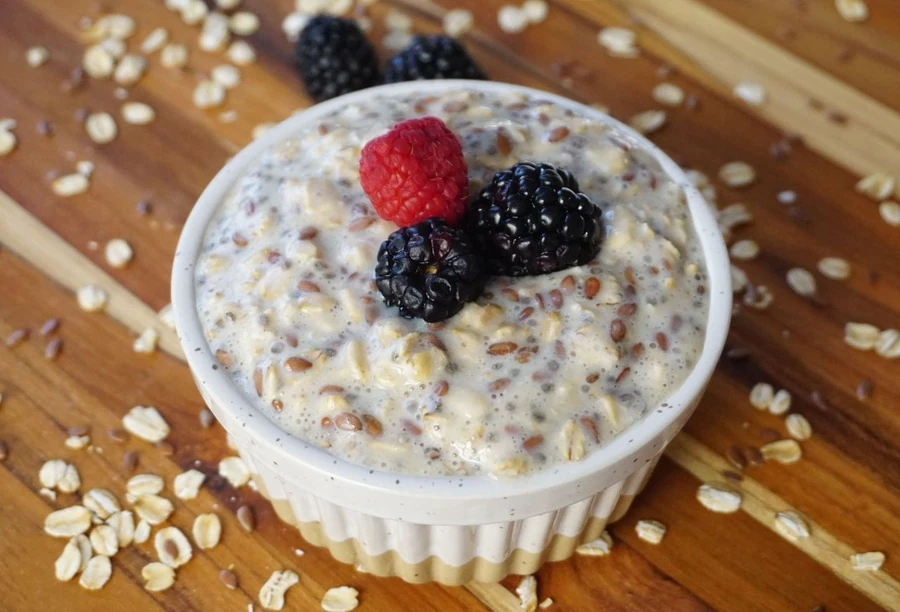
Porridge with chia seeds and berries, plus an egg, from the first sample day. Photo: Livilla Latini / Pexels
Two sample days
These are examples to adapt, not rules. Portions depend on your size, activity and hunger.
Day 1
- Breakfast: a bowl of porridge made with milk, topped with chia seeds and berries, plus a boiled egg.
- Lunch: grilled chicken or fish, half a cup of brown rice, and a large portion of vegetables with olive oil and lemon.
- Snack: an apple or pear with a spoon of nut butter.
- Dinner: lentil soup with leafy greens and carrots, and a slice of wholegrain bread.
- Evening: a small handful of nuts, or a glass of milk.
Day 2
- Breakfast: a smoothie of spinach, berries, plain yoghurt and milk, with a slice of wholegrain toast and mashed avocado.
- Snack: a small handful of nuts and seeds.
- Lunch: grilled salmon with a mixed salad and roasted sweet potato.
- Snack: cottage cheese with cucumber and black pepper.
- Dinner: chicken stir-fried with peppers and mushrooms, over a small portion of rice or wholegrain noodles.
- Evening: warm milk with cinnamon.
This is not a low-carbohydrate diet. It includes oats, rice, bread and sweet potato in sensible portions, which is what makes it sustainable for months instead of weeks.

Keeping to about two mugs of coffee a day avoids an unsettled, wakeful baby. Photo: Anna Shvets / Pexels
Caffeine, alcohol and weight-loss products
Small amounts of caffeine pass into milk. Keeping to about two mugs of coffee a day avoids an unsettled, wakeful baby. If you drink alcohol, wait at least two to three hours per drink before the next feed.
Avoid slimming pills, "detox" teas and weight-loss supplements while breastfeeding. Many contain stimulants or laxatives that can reach the baby, and very few have been tested for safety in breastfeeding. Prescription weight-loss injections such as semaglutide are also not recommended while breastfeeding, because there is too little safety data.
Exercise
Walking with the pram is a good start in the first weeks. Most women can return to more vigorous exercise from around six weeks after an uncomplicated birth, with longer recovery after a caesarean. Moderate exercise does not affect milk supply or the baby's growth. Feeding before a workout is more comfortable.
When to check with a doctor
Seek advice if your baby is producing fewer than six wet nappies a day after the first week, or isn't gaining weight. See a doctor yourself if you feel exhausted, cold, or are losing or gaining weight without trying, which can be signs of a thyroid problem after pregnancy. The NHS guide to diet while breastfeeding has more detail.
Sources
- Lovelady C, Garner K, Moreno K, Williams J, "The Effect of Weight Loss in Overweight, Lactating Women on the Growth of Their Infants", New England Journal of Medicine 342 (2000): 449-453. https://doi.org/10.1056/NEJM200002173420701
- NHS, "Breastfeeding and diet". https://www.nhs.uk/baby/breastfeeding-and-bottle-feeding/breastfeeding-and-lifestyle/diet/




Comments (0)
Leave a Reply
Comments are moderated. Please read our Comment Policy before posting.
Log in to post a comment.