

 Jun 17, 2026
 4 min read
Does Dehydration Hurt Your Spine? What 'Dehydrated Discs' Really Means
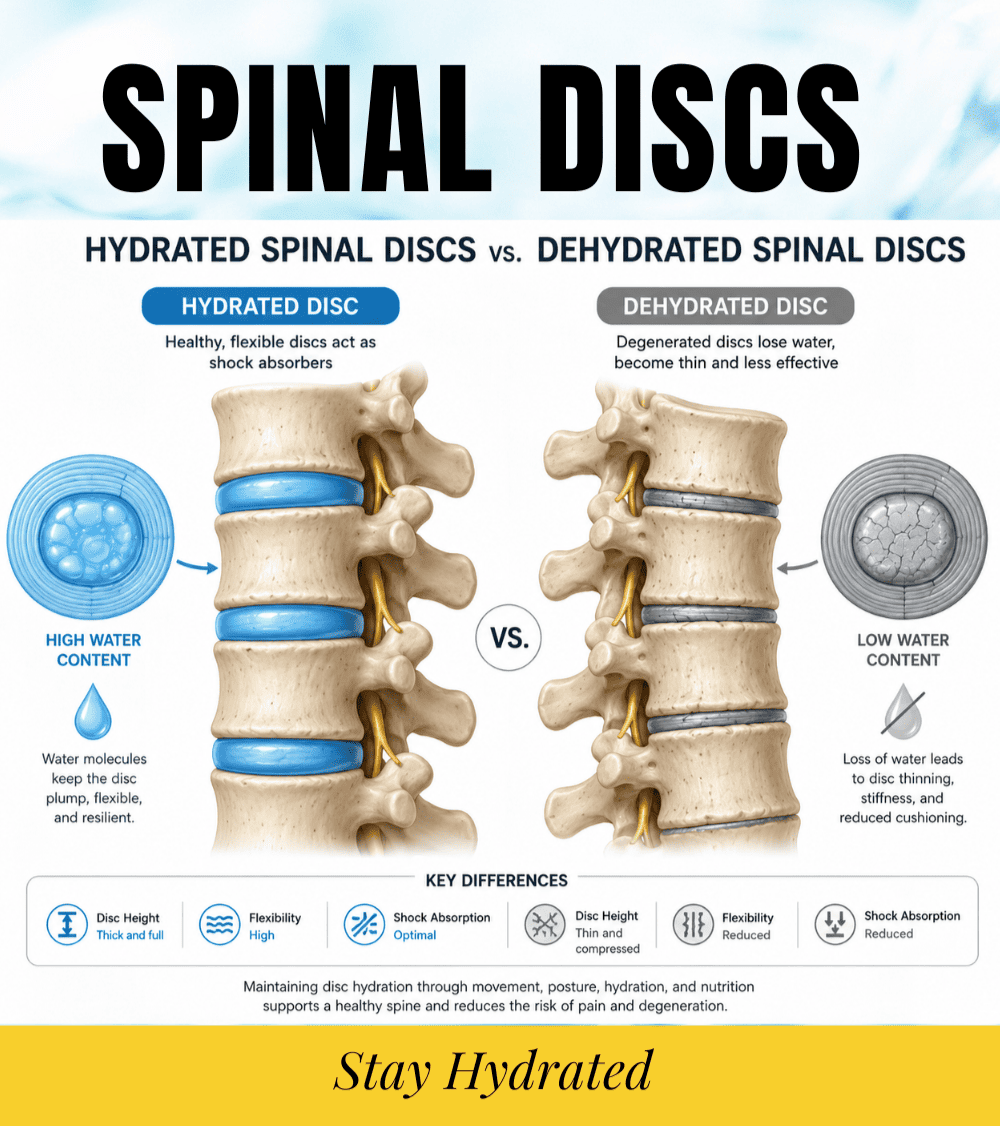
You are about 1 to 2 cm shorter in the evening than when you wake up. During the day, the weight of the body squeezes water out of the discs between the vertebrae. Overnight, lying down, they soak it back up. Astronauts, freed from gravity, grow by up to a few centimetres in space for the same reason, and back pain is common among them. Spinal discs really are mostly water. Whether drinking more water protects them is a different question, and the answer is less simple than it sounds.
How discs hold water
Each disc has a tough outer ring (the annulus fibrosus) around a soft, gel-like centre (the nucleus pulposus). In young adults the centre is roughly 80% water. It holds that water not because of how much you drink, but because it is packed with molecules called proteoglycans, which attract and bind water like a sponge. Discs have almost no blood supply of their own. They take in nutrients and water by diffusion from the vertebrae above and below, helped by the pumping effect of daily movement and loading.
What "disc desiccation" on a scan means
Many MRI reports for back pain mention "disc desiccation" or "dehydrated discs", which understandably makes people think they should drink more. In this context the word describes age-related change: proteoglycans decline over the years, so discs hold less water and look darker on MRI. It is extremely common. Scans of people without any back pain show disc degeneration in over a third of 20-year-olds and in most people over 60. It reflects ageing and wear, much like grey hair. It does not mean you haven't been drinking enough.

There's no good evidence that drinking extra water rehydrates spinal discs. Photo: Burst / Pexels
Does drinking water help back pain?
There is no good evidence that drinking extra water rehydrates spinal discs, slows disc degeneration or prevents back pain. When the body is short of water, it is protected by thirst and by the kidneys conserving fluid. The water inside discs is governed mainly by their chemistry and by loading, not by small day-to-day changes in fluid intake.
That doesn't mean hydration is irrelevant to back pain. Being properly hydrated:
- reduces muscle cramps, particularly in heat or during long physical work
- helps prevent kidney stones, a very common cause of severe pain in the side and back that is often mistaken for a back problem
- helps prevent constipation, which can add to lower back discomfort
Drinking enough to keep urine pale is sensible for all these reasons. Drinking large extra amounts in the hope of "plumping up" discs is not.

In a 2017 MRI study, people who ran regularly had better-hydrated discs. Photo: Ketut Subiyanto / Pexels
What does help discs
Movement and loading. Because discs are fed by being compressed and released, regular movement helps their nutrition. A 2017 MRI study found that people who ran regularly had better-hydrated discs, with more water-binding molecules, than people who didn't exercise. Walking and running at a moderate pace appeared most beneficial. Long periods of sitting without breaks do the opposite.
Not smoking. Smoking reduces blood flow to the vertebrae that feed the discs and is linked to faster disc degeneration and more back pain.
A healthy weight reduces the load on discs and joints in the lower back.
Strength. Strong back, hip and abdominal muscles share the load with the spine. Exercise programmes are the most effective treatment for persistent back pain. Our guide to lower back pain covers what helps and what doesn't.
When back pain needs a doctor
Seek urgent help for back pain with numbness around the genitals or buttocks, new problems controlling the bladder or bowel, or weakness in both legs. Also seek urgent help for pain in the side or back with fever, which can mean an infected kidney. See a doctor soon for back pain with weight loss, fever, a history of cancer, or pain that is constant and worse at night.
Sources
- Belavý D, Quittner M, Ridgers N, Ling Y et al., "Running exercise strengthens the intervertebral disc", Scientific Reports 7 (2017). https://doi.org/10.1038/srep45975
- Brinjikji W, Luetmer P, Comstock B, Bresnahan B et al., "Systematic Literature Review of Imaging Features of Spinal Degeneration in Asymptomatic Populations", American Journal of Neuroradiology 36 (2014): 811-816. https://doi.org/10.3174/ajnr.A4173
- NHS, "Back pain". https://www.nhs.uk/conditions/back-pain/


Comments (0)
Leave a Reply
Comments are moderated. Please read our Comment Policy before posting.
Log in to post a comment.