

 May 25, 2026
 5 min read
The Race Against Time: Organ Survival After Death
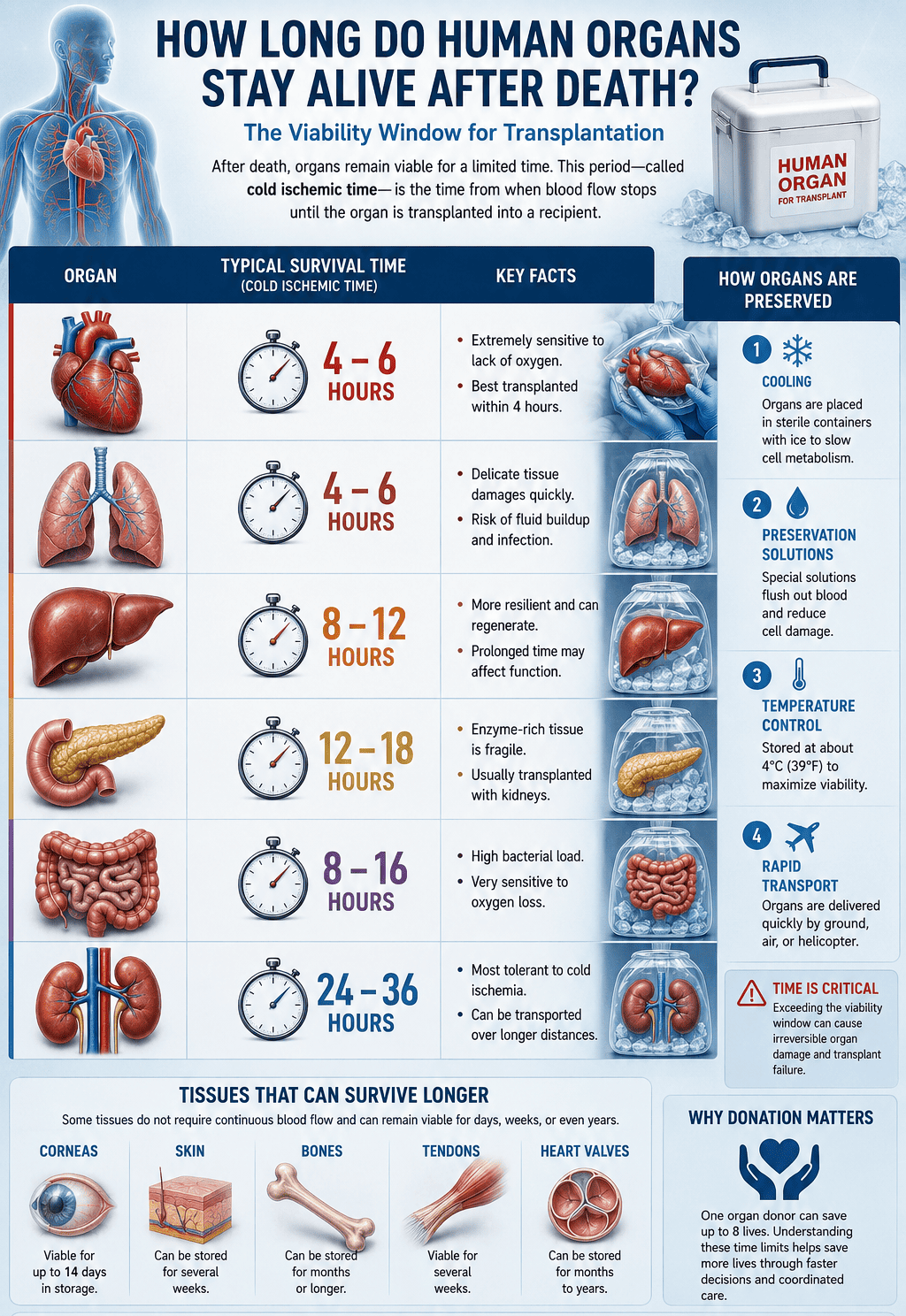
How Long Do Human Organs Stay Alive After Death?
Organ transplantation is one of the most significant achievements in modern medicine.
Each year, thousands of lives are saved because healthy organs from donors are given to patients with severe organ failure. However, once a person passes away, the time available for successful organ transplantation starts immediately. Human organs cannot survive outside the body for very long, and each has a specific period during which it can still work well after being transplanted.
This time period is called the cold ischemic time, which is the time an organ remains healthy after blood flow stops and before it is placed into another person’s body.
Why Organs Stop Working After Death?
The human body needs a steady supply of oxygen-rich blood to function.
After death, blood circulation ends, meaning the organs no longer get oxygen and the necessary nutrients. Without oxygen, the cells in the organs begin to break down quickly in a process commonly known as ischemia.
To slow this damage, transplant doctors quickly take out the donor organs, clean them with special preservation solutions, and store them at cold temperatures.
Cooling the organs slows down their metabolic activity and delays cell death, giving more time for transportation and surgery.
Even with these techniques, every organ has a limit to how long it can stay viable.
Survival Time of Major Human Organs
Heart – 4 to 6 Hours
The heart is one of the most sensitive organs in the body.
Because its muscle cells require continuous oxygen, the heart starts to lose function very quickly after blood flow stops.
Why the Heart Has a Short Survival Time?
- Heart muscle is very sensitive to a lack of oxygen.
- Prolonged lack of oxygen weakens the heart's ability to pump blood.
- Damaged heart tissue may not work properly after being transplanted.
Doctors usually try to transplant a donor heart within 4 hours to improve the chance of success.
Lungs – 4 to 6 Hours
Like the heart, the lungs are very sensitive to injury after death.
Lung tissue is delicate and can become damaged quickly due to inflammation or fluid buildup.
Challenges With Lung Preservation
- Lung tissue is fragile.
- Cells that help exchange oxygen deteriorate quickly.
- The risk of infection increases over time.
Because of this short window, lung transplants must be carefully planned between the donor and recipient hospitals.
Liver – 8 to 12 Hours
The liver is more resilient than the heart and lungs, but it still needs to be transplanted quickly.
Why the Liver Lasts Longer
- Liver cells can handle a lack of oxygen better than heart tissue.
- The liver has the ability to repair itself.
- Cooling techniques slow down liver cell breakdown effectively.
However, if kept too long, the liver may not work properly after being transplanted.
Pancreas – 12 to 18 Hours
The pancreas is often transplanted in people with severe diabetes, especially when a kidney is also being transplanted.
Preservation Challenges
- Pancreatic tissue is delicate and contains many enzymes.
- These enzymes can damage the organ itself after death.
- Keeping the pancreas for longer increases the risk of complications.
Doctors closely watch the conditions to keep the pancreas viable.
Intestines – 8 to 16 Hours
The intestines have a high amount of bacteria and a very active metabolism, making them hard to preserve.
Why Intestines Are Difficult to Preserve
- Intestinal cells start to die quickly without oxygen.
- Bacteria inside the intestines can move into other tissues.
- The risk of serious infection increases rapidly.
Because of these risks, intestinal transplants are among the most complex transplant procedures.
Kidneys – 24 to 36 Hours
Kidneys last the longest of all the major organs that can be transplanted.
Why Kidneys Last Longer
- Kidney tissue can better handle cold storage.
- Modern storage methods significantly slow down damage.
- Kidneys are structurally stronger.
This longer survival time allows kidneys to be transported over long distances, helping more patients get a transplant.
What Happens During Organ Preservation?
After the organs are removed, transplant teams follow several important steps:
1. Cooling the Organ
Organs are placed in sterile containers with ice.
2. Flushing with Preservation Solutions
Special fluids are used to remove blood and reduce damage to cells.
3. Monitoring Temperature
Organs are stored at nearly 4°C (39°F) to slow down metabolism.
4. Rapid Transportation
Organs are moved quickly using ambulance, helicopter, or airplane.
Even small delays can make a big difference in transplant success.
Can Any Body Parts Survive Longer?
Yes.
Some tissues do not need continuous blood supply and can remain useful for much longer after death.
Tissues With Longer Viability
- Corneas
- Skin
- Bones
- Tendons
- Heart valves
These tissues can often be processed, frozen, and stored for days, months, or even years before being used.
The Role of Modern Technology
Scientists are creating new preservation technologies to help organs stay alive for longer after death.
Emerging Innovations
- Machine perfusion systems
- Artificial oxygen delivery
- Organ repair technologies
- Normothermic preservation methods
Some experimental systems keep organs alive outside the body by supplying oxygen and nutrients continuously.
These advancements may significantly increase the success rates of organ transplants in the future.
Why Organ Donation Matters
One organ donor can save many lives.
Although medical technology has improved, the biggest challenge in transplants is the lack of enough donor organs.
Because organs only stay viable for a limited time after death, quick decisions, fast transportation, and proper coordination are essential.
Organ donation offers hope to patients suffering from:
- Heart failure
- Kidney failure
- Liver disease
- Severe lung disorders
- Diabetes complications
Essential Facts to Remember
Human organs do not stay alive for very long after a person dies.
While the heart and lungs only last a few h
ours, kidneys can remain viable for over a day if properly preserved. Advances in medical science continue to improve storage and transportation methods, giving more people a second chance at life.



Comments (0)
Leave a Reply
Log in to post a comment.